Showing posts with label Weight Loss. Show all posts

Feb 4, 2013

Healthy Ideas for Valentine's Day

Valentine's Day is around the corner, and you know what that means: candy, chocolate, more candy, flowers, more chocolate, etc. With all those treats on sale, making healthy choices can be difficult, right?


For me, Valentine's Day is a nice way to set aside some time for my husband and I. Now that we have a bigger family, spending quality time together is even more important. So here are some healthy ways to show that special someone you care.
  1. If you're going with chocolate, buy dark chocolate (at least 70% cocoa). It has phytochemicals and when eaten in moderation, may help prevent heart disease. Hint: make sure cocoa is the first on the ingredient list.
  2.  Go for a walk with your love.
  3. Make a healthy meal together and enjoy by candlelight.
  4. If you do go out to eat, share an entree. It will cut costs and control portions!
  5. Celebrate Valentines Day with your kids with healthy treats like mini-boxes of raisins or pretzels, pencils or stickers.
  6. Be creative: make a Valentines Day craft! Here are some cute ideas from Martha Stewart.
  7. Fore more fun tips, visit the American Heart Association.

What are you doing to celebrate Valentine's Day this year?

Nov 27, 2012

Have a Healthy Holiday

Did you indulge a little over Thanksgiving? I would be lying if I said I didn't eat an extra serving of turkey. An extra roll? Perhaps. Pumpkin pie? Absolutely! But thankfully, one meal of semi-indulgence doesn't reverse all my health efforts for the year. Big sigh of relief.


This year, the holidays come during a time when I'm trying to shed the last few baby pounds, so I really don't want to halt - or reverse - my progress. I've jogged a lot of miles and watched my portions too well to let holiday food get the best of me.

To help stay healthy during the holidays, I use a few tricks so my willpower isn't so maxed out. I mean, really. How many times can I say "no" before finally giving in? So I try to maintain a normal healthy lifestyle and save indulgences only for special occasions.


Here's the plan:
  1. Make time to sweat once a day.
  2. Eat small meals regularly throughout the day.
  3. At holiday parties, eat small portions of foods you really like. Don't waste calories on foods you don't love.
  4. Eat until you're satisfied, not full.
  5. Plan holiday activities that aren't food-centered (make a Christmas wreath, dough art decorations, play games, or take a walk to look at decorated homes).

How are you planning on staying healthy this holiday?

Sep 20, 2012

A Healthy Perspective on Weight Loss


Maybe it's just me, but it seems like everywhere I look in health-related magazines and books, weight loss is the theme. Since recently having my second son, losing weight has definitely been on my mind; how much to lose, when to start, what plan to follow, etc? 

Unfortunately, much of the popular press is no help. There seems to be no consistency in what nutrition plan or "diet" works for the long term. Between cleanses, fasts, very low calorie diets, gluten-free, vegan, paleo, etc, it can be very confusing. Naturally, this hodgepodge of diet advice is usually accompanied by images of underweight models and other body types that aren't realistic - or healthy - for most people. Frustrating, right?

Is this what every woman's supposed to look like?? 
I don't think so.


The reality is that we all come in different shapes and sizes and health cannot be defined exclusively by numbers on a scale. Striving for a "perfect" weight can not only lead to disordered eating, but it can take the focus away from the real purpose of being healthy - to enjoy your life!

According to an article from the Academy of Nutrition and Dietetics, there is no "ideal body weight". Living a healthy life can be achieved by following a few simple principles:
  1. Eat a healthy, balanced diet
  2. Get regular physical activity
  3. Look at your health habits and find ways to change those that are unhealthy
  4. Make time for regular physical check-ups
  5. Have your blood pressure, cholesterol, blood sugar and triglycerides checked regularly
Interestingly, following these principles often leads to achieving and maintaining a healthy weight, that is, a weight that allows you to enjoy life and be active. I keep all this in mind as I embark on post-baby weight loss round two! My goal is not to get wrapped up in the numbers-game, but to eat well, exercise regularly and enjoy my life. Here I go...

Aug 1, 2012

Do You Have a Healthy Relationship with Food?

The relationship between the brain and the body is pretty interesting, especially when it comes to food. Have you ever found yourself wanting to eat something unhealthy and doing everything within your power to overcome temptation? I can certainly relate. For some reason, I thought it was a good idea to make cinnamon rolls last week. (Editors note: I'm 40 weeks pregnant and therefore cannot be held responsible for my decision making). So I made them, ate one, gave half of them away to friends and put the rest in the freezer. Thus far, it has taken every last shred of self-control not to break into my stash. Sound familiar?

So what's your solution to temptation? Pantry purge? Get rid of all "unhealthy" foods in the house? Give in and eat what you want or have a small bite, then walk away? Your reaction not only reveals what you would do, but also how you relate to food, which is just as important as what we ultimately put into our mouths.

Working in nutrition, I've seen a lot of disordered eating. These are not just clients with anorexia or bulimia, but oftentimes people I meet day to day. Between the media, unhealthy body images, the latest diet trend, social pressures and more, it can be very difficult to maintain a healthy perspective on what we eat. From what I've observed and studied, I've come to believe it's not just about telling people what to eat, but helping them think about food in a new, healthy way. In order to change how you think, it's important to know the difference between healthy and unhealthy thoughts and behaviors when it comes to food. 

Here's the Tiffany the Dietitian version of some of the "signs" of a healthy vs. unhealthy relationship with food. Ask yourself which way you feel most of the time.


This list could go on. What are some healthy vs. unhealthy perspectives you've observed?
  

Jun 29, 2012

4 Breakfasts Under 400 Calories


Eating breakfast is an important way to start the day. As a breakfast person, I usually have something in my mouth no more than 20 minutes after I roll out of bed. I've heard people say that breakfast is "the most important meal of the day" but from a metabolism perspective, it's one of three important meals of the day. So don't skip lunch or dinner; they're important too.

There's no ideal time to eat breakfast, it just depends on your preference and time schedule. For example, if you workout in the morning, it's good to eat something about an hour before you exercise. Whatever time you decide, eating breakfast helps jump start your metabolism and gives your body fuel to start the day strong. 

If you're like a lot of people, you may find yourself eating the same ol' thing most of the time. Cereal, eggs, toast, repeat. I like finding new ways to add variety while still allowing for a quick prep time. 

It's also important to make sure breakfast is nutritious and well-rounded. For example, try including a source of grains, fruit and/or veggies and protein. A lot of people forget to include protein with breakfast, but this is a great way to help you feel fuller so you're not starving come lunchtime. My current favorites are omega-3 fortified eggs, veggie sausage patties, low-fat yogurt or cottage cheese and low fat turkey sausage links.


Here are a few of my favorite healthy breakfasts that don't break the calorie bank.

4 Breakfasts Under 400 Calories

2 whole grain freezer waffles, 1/2 cup fruit, 1/2 cup cottage cheese

Veggie scramble with 2 slices of whole grain toast
(Scramble 2 eggs and add frozen spinach or your choice of veggie. Finish off with a sprinkle of american cheese. So yum.)

3/4 cup oatmeal (cooked) with raisins and cinnamon, 
1 hard boiled egg

2 slices of whole wheat french toast with 1/2 sliced banana, 
1 veggie sausage patty


Jun 20, 2012

"Bread is the Enemy" and Other Tall Tales

The more people I talk to about diet and nutrition, the more I'm convinced we have a serious case of bread-phobia in America. You've probably heard it too. How many people have you heard say they're "staying away from bread" in an effort to lose weight? Yeah.


At this point in the conversation, I usually explain the fact that weight is based on the principle of calories in, calories out, blah, blah, blah. This is never a popular answer. Why? Because it means that weight loss isn't easy; it means you have to eat less, move more, and develop new habits that form your lifestyle. It means you'll have to say no to seconds at dinner and eat sweets less often. It means you have to make a commitment to your health.....and stick with it.

It also means you'll have less risk of developing chronic disease, may live longer and have a higher quality of life, among many other things. I don't know about you, but that sounds worth it to me. Admittedly, changing lifelong habits is no easy task. And it seems that in an effort to avoid this, too many people simply resolve to avoid "bad" foods (common food-phobias include bread, bread products, meats, sugar, dairy, etc.) which can - and frequently do - result in nutrient deficiencies and other health problems.

Interestingly, amidst the bread and other food-related phobias, America has a record number of people with obesity, diabetes, high blood pressure and hyperlipidemia, all of which are lifestyle-related diseases. It seems as though avoiding bread just isn't working.

Articles on the internet like this one don't help much either. Here, a journalist postulates his theory that America is in an obesity epidemic due to grain products and sugar. His article, of course, completely ignores well-accepted and tested research that people are eating more than ever before. A lot more. According to the USDA, daily calorie consumption in America in 1970 totaled 2,170 calories whereas in the year 2000, daily calorie intake increased to 2,700. That's a 530 calorie/day increase, which leads to gradual weight gain overtime. Wait a minute, that's exactly what we've seen! In 1980, about 46% of US adults were overweight whereas 67% of adults were overweight in 2000. Now, about 1/3 of the US population is obese, according to the CDC. There is no doubt the trend toward overweight and obesity in the US continues to rise. The question is why. 

As I mentioned before, many people want to blame specific food groups: meat, sugar, bread, dairy, gluten, etc. I've heard them all. I admit, we do tend to eat a lot of breads and sweets. But labeling one or multiple foods as "bad" only perpetuates the problem of disordered eating and disordered thinking. Food is not the enemy; it's how we use it.

Some the major reasons we have weight-related problems in the US are related to the increased availability of food, more eating out, less cooking at home, sedentary lifestyles, and more disposable income. In summary, for various reasons, we eat more today than we did 50 years ago. 

The even more complicated question is how to resolve this problem. The answer involves understanding not only biochemistry, but psychology as well. Working with a healthcare provider - such as a registered dietitian - who provides not only education but continued support and accountability is what I've observed to be the most effective strategy for achieving and maintaining a healthy weight. I not only believe this, I've seen it work. Every. Time.

So next time someone tries to tell you that bread is the enemy, thank them for the advice and tell them that you're into eating a healthy, well-balanced diet. It'll rock their socks off.

Jun 5, 2012

Should You Go Paleo?

I'm a big fan of exercise. There's nothing quite like the feeling of a good workout. During a normal week, I try to do 4-5 days of cardio and 3 days of weight lifting. Recently, I wanted to give cross-fit a try since the program incorporates both cardio and resistance training. 

After a session, I decided I really liked the workout. I was a little surprised however when I saw the diet the cross-fit gym advocated: The Paleo Diet. Posted on the walls were things like "you're probably allergic to grain" and "avoid dairy". Also written in bold letters were foods that "you should eat". These included primarily meat, poultry, fish, fruits and vegetables.

Image from: http://www.marksdailyapple.com/how-to-succeed-with-the-primal-blueprint/#axzz1wz8D8wju
To me, the Paleo Diet sounds a lot like a revised version of the Atkin's diet (and we all know how that tune goes); emphasis on protein, fruits, vegetables and a view that carbs are the enemy. As I understand on the Paleo Diet, complex carbs like pasta and rice are allowed in moderation for athletes, especially during recovery. But in general, it is a high-protein, high-fat, low-carb diet that promises weight loss and the potential resolution of health problems like heart disease and diabetes.

Apart from the tendency to disordered eating I've witnessed many people experience when trying to eat "low-carb", here's the big problem with the Paleo Diet: it identifies the right problem (obesity in America) with the wrong solution (low-carb dieting). Carbohydrates are the primary source of fuel for our bodies, especially during periods of intense activity (like....say, a cross-fit workout). That said, there is no question America is in the midst of an obesity epidemic. The solution to the problem is simple in theory: eating healthy foods in smaller portions and moving more. The application of this solution is the challenge and involves much more than simple calories in, calories out dogma. Truly becoming healthy involves a commitment from both your mind and your body, and that is no easy task.

Still, it's important for those seeking weight loss or general health to remember that the latest fad diet is usually not the solution to lasting change. A few other problems with the Paleo Diet are the nutrient deficiencies that can occur overtime when restricting dairy and grain products (for example, Calcium, Vitamin D, B Vitamins, fiber and more). For those with health problems like diabetes, the Paleo Diet can increase risk of blood sugar abnormalities due to the lack of carbohydrates. 

So, did I become a cross-fitter? No, but not because I was offended by the diet. I actually really enjoyed the workout, but the price tag just doesn't fit the budget right now. Instead, I do similar workouts at home and stick to a truly well-balanced, healthy diet. 

It looks a little something like this.


What are your thoughts on the Paleo Diet? Have you tried it?

Apr 12, 2012

Q & A with the Dietitian: Which Bread to Buy

If you're like most people, choosing the healthiest foods at the grocery store is no simple task. After you consider all the different products, sort through the health claims on the label, factor in price, and tell your 2 year old for the twentieth time to sit still, it can get a little very overwhelming. Bread is one example where there are a LOT of choices and knowing the best can be challenging.


Question:
Cameron wrote: "When I'm buying bread I'm overwhelmed with the amount of options there are for BREAD! Options vary from whole grain, whole wheat, seven grains, cracked oat, rye, white, buttermilk... are just a few off the top of my head. My question is... When making a sandwich... does it REALLY matter or make a difference? If so, which is best??"

Answer: 
Making the switch to whole grain bread totally matters. Why? Because it's one of the easiest ways to increase your intake of whole grains, which should comprise at least half of the grains you eat during the day. 

Most Americans don't eat enough whole grains, which provide so many health benefits such as vitamins, minerals, antioxidants, protein and fiber to help keep you fuller longer. They also may help reduce the risk of some chronic diseases and promote a healthy weight. Good stuff, right? Sorry Wonder bread; you lose. 

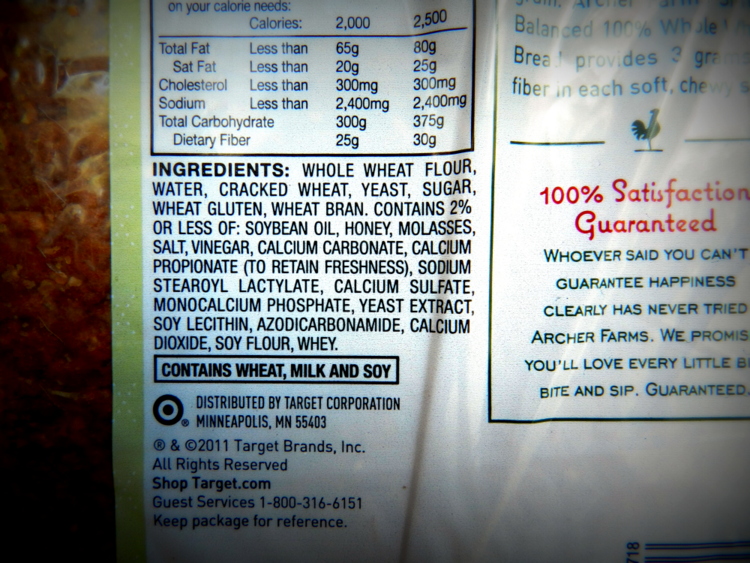
Now onto which bread you should buy. Stick with those labeled "100% whole wheat bread", as seen in the picture above. The first ingredient of 100% whole wheat bread will be "whole wheat flour". Check it out!

 
Thankfully, most major brands carry this option and you'll probably want to try a few different brands to see which one you like the best. I got mine this week from Target and really like the texture and quality. I can honestly say though that I've had to shop around because they all taste a little different to me. See what works for you.

Other whole grain options to include in your diet throughout the day are brown or wild rice, oatmeal, whole grain crackers, whole wheat pasta and popcorn. 


Thanks for your question Cameron!

Jan 10, 2012

Q & A with the Dietitian

It's question & answer time!

Do you have a nutrition question you want answered? Wondering whether a certain food is actually healthy? Need tips on making affordable healthy meals? Hitting a weight loss plateau and need advice? Or maybe you want to know more about getting your kids to eat nutritious foods? You ask it, I'll answer it. Send me your questions at tiffanythedietitian@gmail.com.

First question.....


QUESTION:

Hi Tiffany! Do you know what the final word is on a high dairy diet and weight loss? I know it's bounced around from dairy bad to dairy good. I was just curious because my weight loss has really slowed down even though I haven't changed my exercising and I've continued to slightly decrease my calories the smaller I get. (it's 1450 right now) so I'm looking a tweaking something, anything to help with my last 30 pounds. Thanks!!

--Andree

ANSWER: 

Hi Andree!

According to Registered Dietitians, as long as you don't have a dairy allergy, dairy products have always been considered healthy to include in your diet. Why? It offers calcium, vitamin D, protein, and carbohydrates to help keep you strong and energized. 

The dairy industry advertise that milk products can help you lose weight. This is only true as long as your total calorie intake is below your calorie needs. So, the weight loss comes from a calorie deficit rather than simply consuming dairy products. Aim to consume 3 servings of low fat dairy products per day as part of a healthy diet.

Now on to weight loss. Although it was not stated in her question, I'll give a little background : Andree is very active and exercises intensely at least 5 days per week, which in turn increases her calorie needs. After a few calculations based on height, weight and activity level, Andree should be eating at least 1600-1800 calories per day for weight loss. As odd as it may sound, it's important to eat enough calories when trying to lose weight to prevent your metabolism from slowing down. When we under-eat, a message is sent to our brains to slow our metabolisms to prevent starvation. To avoid this, it's important to eat adequately and only slightly less than your normal calorie intake.

The best way to determine your metabolic (i.e. calorie) needs is to consult a dietitian. A less precise, but still effective way is to figure out how many calories your body burns to maintain your current weight. Do this by recording what you eat for 2-3 days and adding your total calorie intake per day. Then, reduce that number by 250-500 calories per day and healthy, gradual weight loss will result.

Jan 5, 2012

Change your life and the body will follow

It's January and I guess that means it's time to get back in the gym.

I took a spin class this morning at a gym I'm considering joining and MAN - did it kick my butt! Every 15 minutes felt like 30. Over our holiday vacation in So Cal, I visited a local gym to take a little "me time" and workout. On the wall prominently displayed was this poster:

"Change your body, change your life"


To me, this sign sends the message that once you get that sexy body you've always wanted, your life will be better....maybe even sexy? Does the body really come first, then the great life? Or do you change your life, then see your body change? Hmmmm.....I'll go with option B.

This advertisement - like so many today - focuses on body image. Maybe it's just me, but I'm tired of the media directing so much emphasis on body image. Most of the time, the "ideal image" portrayed is far from healthy and it sends an unrealistic message to both women and men. The truth is that people come in all shapes and sizes: pear shape, apple shape, square shape, whatever. It's important to remember that regardless of whether your shape conforms to the model on the cover of a magazine, you can certainly still be healthy.

If I could re-write this poster, it would say: "Change your life and the body will follow". That may not sell gym memberships as well, but it certainly is more truthful about the real way to achieving lasting change.

Making healthier eating choices, exercising regularly, taking time to de-stress and getting plenty of rest are a few of the major components of a healthy lifestyle. Once these have been adopted, your body will change. Guaranteed.

So be kind to yourself my friends and remember that health comes in all shapes and sizes.

Nov 15, 2011

Post-Pregnancy Weight Loss

Attention ladies! If you're trying to lose post-baby weight, I have some real-life tips to share.

And even if you didn't just have a baby, but want to lose weight, these tips can help you too. Promise.

My advice goes beyond the basics. Yes, there's the low calorie diet thing. Yeah, ok, there's the exercise thing too. But it's more than that. It's more than just giving you rules to follow. There's a person behind all this. A person who cares for you and has totally been there.

This is very pregnant me in March 2010. I gained about 30lbs, then had to lose it. Real life.


About a year and a half ago when I had my son - my little bundle of joy - he filled my heart with love and my belly and thighs with much, much more. Totally worth it. But still, like many women, I wanted to get back into my pre-baby shape A.S.A.P and learned a few things along the way.

This was the first time in my life I had to lose real weight. Not just a few pounds...30 of them. Ok, technically about 23 after Will was born. But still! In my line of work, I'm used to giving recommendations on weight management. Losing weight, gaining weight, maintaining weight - I thought I had it all figured out. NOT! The first thing I learned after having a baby is that it's a lot easier to give advice about weight loss than to actually DO it yourself.

If you're one of my close friends, you know I struggled for the first few months. The weight just wasn't coming off. Why? I didn't trust what I knew. Bizarre. I blame the hormones. I knew I needed to eat enough calories to support breastfeeding and exercise. I knew my calorie and protein needs - I calculated them to the T. I knew what I needed to do. Did I do it? No.

Instead, I thought, "I'll just eat slightly less calories per day than I calculated and the weight will come flying off". Did it? No. It didn't. Why? Because I didn't trust what I knew. My initial lack of success frustrated me. Couple that with mental and emotional challenges of having a newborn and I was a hot mess!

So I decided after a few months to go back to basics....to what I knew. Start eating more calories in small frequent meals throughout the day. I continued exercising. After 6 months, I was back to pre-baby weight.

Me and my crazy-eyed friend. Back in shape and living it up at my best friends wedding in September 2011.


So what did I learn from all this? Trust what you know and be patient. It'll happen. Not overnight, but it'll happen.

Even though everyone has unique nutritional needs, here my general post-pregnancy weight loss pro-tips:
  • DO aim to lose weight at a healthy rate (i.e. about 1-2 pounds per week)
  • DO eat real food (no fad diets or crazy detoxes)
  • DO eat enough food (if you're breastfeeding, that's usually about 2,000 calories or more)
  • DO exercise moderately (about 30-60 minutes 5 days per week)
          and most importantly.....
  • DO be patient and stick with it!
Is it easy to lose weight? Not always. But it's worth it for your health in the long run. Remember to forgive yourself when you make mistakes. We've all been there. Just pick yourself up and start again.